FITS Method
Functional Individual Scoliosis Therapy
Part 1: June 11–14, 2026
Part 2: August 27–30, 2026
Part 3: October 8–11, 2026
COMPREHENSIVE DIAGNOSIS AND TREATMENT OF SCOLIOSIS, POSTURAL DISORDERS, AND SCHEUERMANN’S DISEASE
This method is recommended by SOSORT (Society On Scoliosis Orthopedic and Rehabilitation Treatment).
3 MAIN STAGES
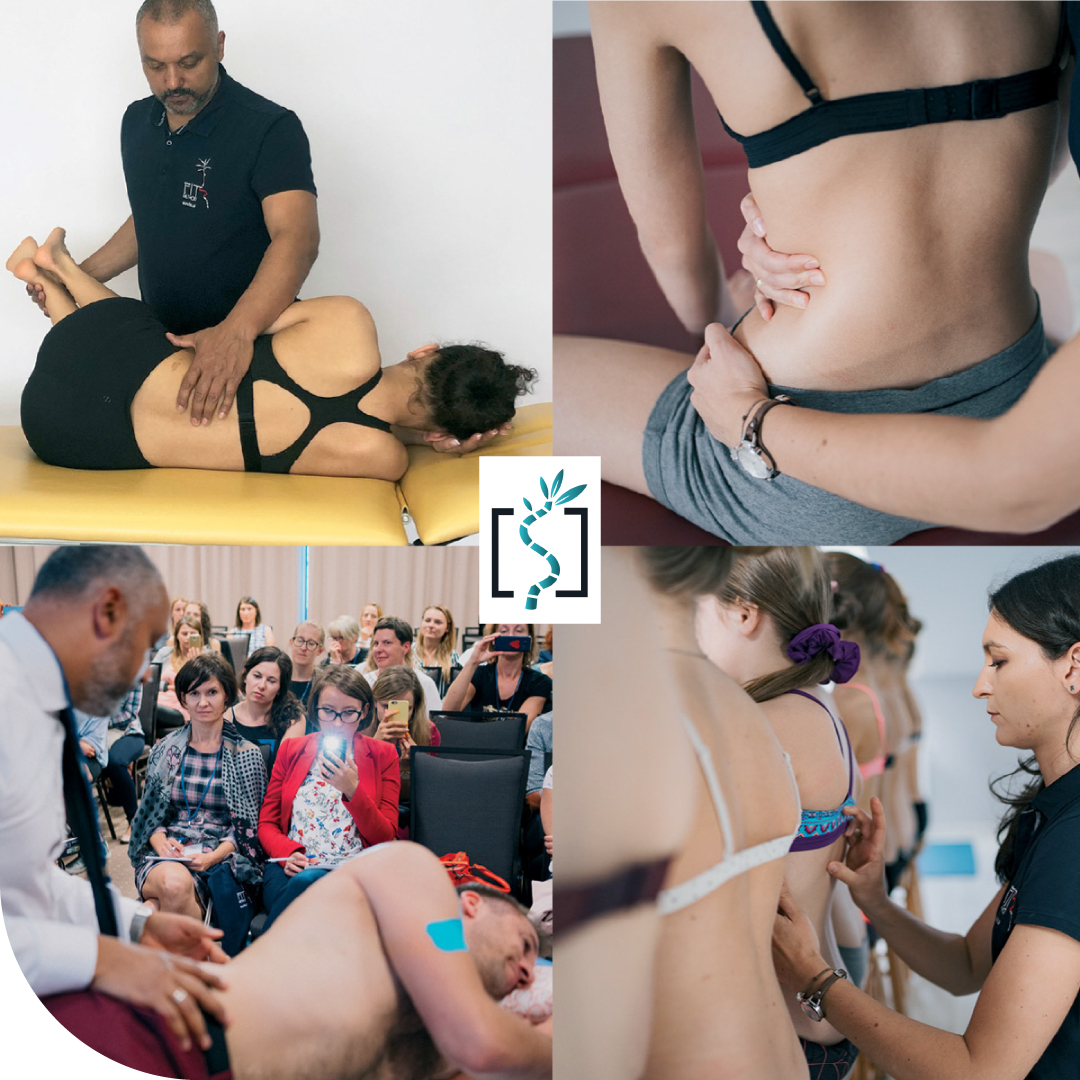
• Assessment of the patient using the FITS approach and education to raise awareness about their deformity.
• Preparation for correction: Sensory-motor balance training, identification and release of myofascial tension restricting corrective movements in three planes.
• 3D Correction: Developing corrective patterns and stabilization in open and closed biokinematic chains and functional positions.
KEY AND INNOVATIVE ASPECTS OF THE FITS METHOD
• Make the patient aware of the existing deformities of the spine and trunk.
• Psychological aspect – the patient is not a subject.
• Sensory-motor balance training to improve nervous system control over muscle function.
• Evaluation of active and passive corrective movements.
• Release of myofascial structures limiting 3D corrective movements.
• Correction of the primary curve by developing functional compensations.
• Creation of corrective patterns and stabilization in open and closed biokinematic chains and functional positions.
Each year, approximately 150 physiotherapists, physicians, and orthosis specialists are trained.
AFTER THE FITS TRAINING:
• You will learn when to refer the patient to a doctor and how to assess scoliosis braces.
• You will gain the knowledge necessary to professionally treat patients with scoliosis.
• Graduates can also apply the skills they gained during the training under the supervision of their instructors in the patient’s rehabilitation process.
FITS METHOD – Comprehensive Diagnosis and Treatment of Scoliosis, Postural Disorders, and Scheuermann’s Kyphosis
Part 1
1.FITS Method – history, basic principles, stages of developing corrective patterns
2.Biomechanics of the spine
3.Biomechanical analysis, assessment, and correction of the foot and knee
4.Sensory-motor balance training and lumbopelvic stabilization
5.Myofascial techniques for the lower extremity
6.Clinical examination of a scoliosis patient according to the FITS method
7.Clinical examination of the pelvis and assessment of lower limb length
8.Corrective patterns of the pelvis and lower extremity in Th/L scoliosis
9.Scolyogenesis – etiology, pathogenesis, and pathomechanics of scoliosis
10.Risk factors in scoliosis progression
11.Classification of scoliosis according to the FITS method
12.Corrective patterns of the scapula and upper extremity in thoracic scoliosis
13.Corrective patterns of double-curve scoliosis in open and closed biokinematic chains
14.Study of corrective shift movements for the primary curve in functional positions
15.Myofascial techniques for trunk and pelvic muscles
16.Treatment methods to enhance corrective shift movements
17.Functional compensation – basic principles
18.Patient self-therapy as home exercise
⸻
Part 2
1.Classification of scoliosis according to the FITS method
2.Corrective patterns of the scapula and upper extremity in thoracic scoliosis
3.Corrective patterns of double-curve scoliosis in open and closed biokinematic chains
4.Study of corrective shift movements for the primary curve in functional positions
5.Myofascial techniques for trunk and pelvic muscles
6.Treatment methods to enhance corrective shift movements
7.Functional compensation – basic principles
8.Patient self-therapy as home exercise
9.Fundamentals for planning functional and structural compensations and corrective patterns
10.Corrective patterns in functional positions and for three-curve scoliosis
11.Patient treatment presentation
12.Diaphragm – assessment and treatment
13.Myofascial techniques for the chest to facilitate derotational breathing in Th and Th/L scoliosis
⸻
Part 3
1.3D derotational breathing for Th and Th/L scoliosis
2.X-ray analysis in patients with scoliosis and Scheuermann’s disease
3.Scheuermann’s disease – assessment and treatment
4.Myofascial techniques for cervical spine and shoulder girdle muscles (suboccipital, sternocleidomastoid, levator scapulae, trapezius, pectoralis major and minor, latissimus dorsi, and erector spinae)
5.Brace treatment in scoliosis
6.Corrective patterns and 3D breathing in brace treatment
7.Treatment of scoliosis using myofascial chains
8.Derotational techniques for single and double-curve scoliosis
9.3D auto-correction in daily living activities
10.Long-term treatment planning
The second part of the course includes 3 one-hour practical sessions with patients.
At the end of the practice, the treatments are discussed.
Throughout the course, participants will engage in 80% practical and 20% theoretical training.